Great article about Marina Abramovic and the new exhibit at MoMa dedicated to her work. Abramovic is the performance artist we were talking about on Monday night.
http://www.nytimes.com/2010/03/12/arts/design/12abromovic.html?8dpc
“Marina Abramovic: The Artist Is Present” is opening at MoMA this sunday and is remaining on view through May 31.
Hope everyone has a great spring break !
Friday, March 12, 2010


Thursday, March 11, 2010

Homage to the Square
This was my first visit to the Hirshorn Museum and Sculpture Garden so I did not really know what to expect to see when I arrived. Before I visited the museum, someone mentioned in class that the only exhibition that they did not personally like at the museum was the one titled, “Homage to the Square.” So when I arrived at the museum this was the first artwork that I went looking for, as I wanted to see if I would get a similar reaction to what my classmate experienced. At first I had a very similar reaction, as I was almost bored when I first set my eyes on the large amounts of squares that surrounded me. But my thoughts changed when I took another look at the squares and really studied each piece both individually and as a whole collection. His work really stands out to anyone passing by due to the bright colors that catch your eye and capture your attention. Also due to the large amount of paintings you can’t help but notice as there are so many of them all around you. I did some research online and it said that this work by Josef Albers is his most well known and that, “these images create optical illusions, and challenge viewers’ visual acuity.” I really enjoyed how this artist was able to take such a simple concept and turn it into a beautiful and visually interesting piece. One would not normally think of different colored squares as art, but he really challenges his viewers to look at art with a more open mind and se it through a new pair of eyes.
Wednesday, March 10, 2010
Next Floor

During my visit to the Hirshhorn yesterday I was most intrigued by a piece entitled "Next Floor" by Phoebe Greenberg. It was a film 12 minutes long that was a direct commentary on how we consume too much as a society. While none of my own photography focuses on meaning like that, I do think it's an important point to be made. The film is set in a building with an infinite amount of floors in which a group of scary dictators, royalty, and so on are eating a meal. The meal is one of the most grotesque things I've ever seen. The waiters who have a very devilish look about them continue to feed the group at the table until they fall through the floor to the level below. This continues for several floors until it gets to the so called threshold and the gluttons at the table just begin to continue falling from floor to floor, never to be seen again. Truth be told, I had trouble watching it because I was so grossed out. I think that's exactly the point though, to question how they could be consuming such repulsive things and be so gluttonous about it nonetheless. There in lies the meaning of this short film though, the over-consumption of our society and the inevitable breaking point.
Monday, March 8, 2010
Inspirational Photo - John Doar

John Doar, my Grandfather, is a man who never looks for much praise or recognition, although I know he enjoys it from time to time. Born in a small town in Wisconsin he left his quiet life as a young lawyer to work in Washington D.C. for the Civil Rights Division of the United States Justice Department. Spending most of his time traveling in the deep South, trying to understand the problems that many people had been avoiding, it was his job as a civil rights lawyer to expose corruption and empower black communities. When people ask him why he did what he did and how did he find the courage, he answers in a calm, matter-of-fact manner that he was just doing the only type of work that he knew how to do.
This picture was taken in 1963 during a hot summer day in Mississippi. On the side of the street that you can see in the background of this image stood hundreds of trigger itchy local lawmen and on the other side of the street, invisible to the viewer, stood hundreds of African-Americans filled with grief and anger. They had just left the funeral of Medgar Evans, the field secretary of the NAACP, who a few evenings earlier had returned home after a long day of work only to be shot in the back as he got out of his car, his wife and children just inside the door.
While walking down the white business district singing “This Little Light of Mine” the peaceful protest began to escalate into a possible violent confrontation. There in the middle of two angry mobs my grandfather stepped out. Bottles and bricks were flying past his head and police dogs biting at his heels, but with the same familiar calm he stood tall and spoke to the crowd. “You’re not going to win anything with bottles and bricks. My name is John Doar – D-O-A-R, I’m from the Justice Department and anybody around here knows I stand for what is right.” He explained how Medgar Evans would not have wanted this and urged the crowds to disperse. Reporters who were present wrote about that day as being well on its way to becoming a violent riot of epic proportions if it was not for John Doar.
That day my grandfather did something that no lawyer is expected to do but as a friend of Medgar Evans, he told Charles Potis of the Los Angeles Times “it seemed the only thing to do.” It is not always about doing what you are asked to do but about doing what is right even in times of controversy or when there are possible consequences. This image reminds me of my grandfather’s courage and the values around which he lived his life.
Dovima with Elephants

Dovima and the Elephants
"A Morir, Miguel Angel Rios"

I think what I really responded to in this piece was the raw power of the spinning tops. This was conveyed by a few means. The first of these was the perspective on the action. Besides the interesting fact that there were three different angles to look at simultaneously, the perspective was generally very low to the "ground" and up extremely close to the tops. As such, a whirring top could burst into the picture at any given moment, perhaps stopping perfectly and spinning right in front of you, knocking into other tops at high velocity, or whizzing right by and back out of the picture.
Besides the close up perspective, there was the quality of the sound which enhanced the sense of speed and intensity. I'm sure I'm not the only one to notice that it sounded eerily like a bombing raid being conducted overhead, with the whirring of the tops sounding much like airplane engines - first becoming louder and louder until they blew past you and the sound receded. All of this detailed surround sound led me to intimately feel the physicality of the tops.
This sense of power and motion was so palpable that I felt myself beginning to assign human characteristics to the tops. Some were larger than others and spun so quickly and with such force in one place that any smaller top which came into contact with them would quickly be blown away. These large tops seemed to me to be "proud" in the most self-satisfied sense, while the smaller tops were never as secure in their space and struck me as "timid" and afraid of their dangerous surroundings. Though the entire film is under five minutes long, near the end I was wholly engrossed in the struggles of these little beings (as I had begun to perceive them). When they slowly began to fall, their momentum withering one by one, I could not help but sense that this was an inexorable process and that their energy would not be replenished. That this would be a tragic occurence seemed a natural thought to me, and I perceived a degree of dignity in the way the last few tops stubbornly clung to motion until they hit the floor with a thud. I have to give Rios credit for getting me to so empathize with a bunch of tops and for bringing to light my own strong association between life and motion.
Hirshhorn Museum_Death
I enjoyed my visit to the Hirshhorn Museum very much and I had tons of fun playing color games of Josef Albers and admiring John Garrad's fabricated reality. I like many of the artworks, such as the "Map" by Evan olloway and the "Green House" by Michael Lucero. However, I would like to talk about "Til Death" by Minguel Angel Rios and "Play Dead, Real time" by Douglas Gordon. Both of the artists use black and white to represent the feeling of death, it is cold, restrained, and hopeless. Yet both artists connect movement or life with death; death is the ultimate end of all lives and energy.
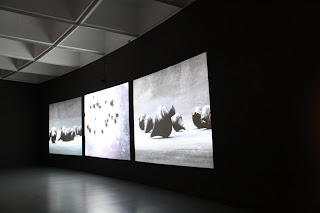 I especially like Minguel's piece. For me, all those turing tops are representations of human beings and the white gribs on the floor symbolize the different paths that people take in their lives. While human beings are walking their separate paths, they meet each other, love each other, or even hurt each other. However, at the end, we would all be tired and death seems to be the only ending of all. ( I also like our classmate Mel Turley's interpretation of soldiers and battlefield.)
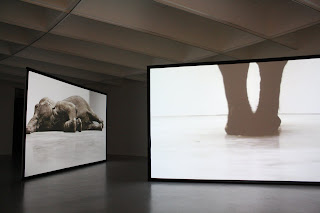 On the other hand, I also like the way Douglas express death through movement. Since the real time short film is made from a 360 degree perspective, it gives me an impression that the elephant is walking in circles and is trapped in that little squared room. It seems confused, hopeless, sad, but yet calm and quite. The small TV on the floor provides us with the facial expression of the elephant; it is hurt to see those teary and lifeless eyes.
The two pieces provide me with two contradictory human views toward death. "Til Death" represents the human attitude of avoiding death by fighting to live or breaking through the constrains of life. "Play dead" represents the human attitude of accepting death as it is and live a calm life within the limitations.
 I especially like Minguel's piece. For me, all those turing tops are representations of human beings and the white gribs on the floor symbolize the different paths that people take in their lives. While human beings are walking their separate paths, they meet each other, love each other, or even hurt each other. However, at the end, we would all be tired and death seems to be the only ending of all. ( I also like our classmate Mel Turley's interpretation of soldiers and battlefield.)
 On the other hand, I also like the way Douglas express death through movement. Since the real time short film is made from a 360 degree perspective, it gives me an impression that the elephant is walking in circles and is trapped in that little squared room. It seems confused, hopeless, sad, but yet calm and quite. The small TV on the floor provides us with the facial expression of the elephant; it is hurt to see those teary and lifeless eyes.
The two pieces provide me with two contradictory human views toward death. "Til Death" represents the human attitude of avoiding death by fighting to live or breaking through the constrains of life. "Play dead" represents the human attitude of accepting death as it is and live a calm life within the limitations.
Subscribe to:
Posts (Atom)


